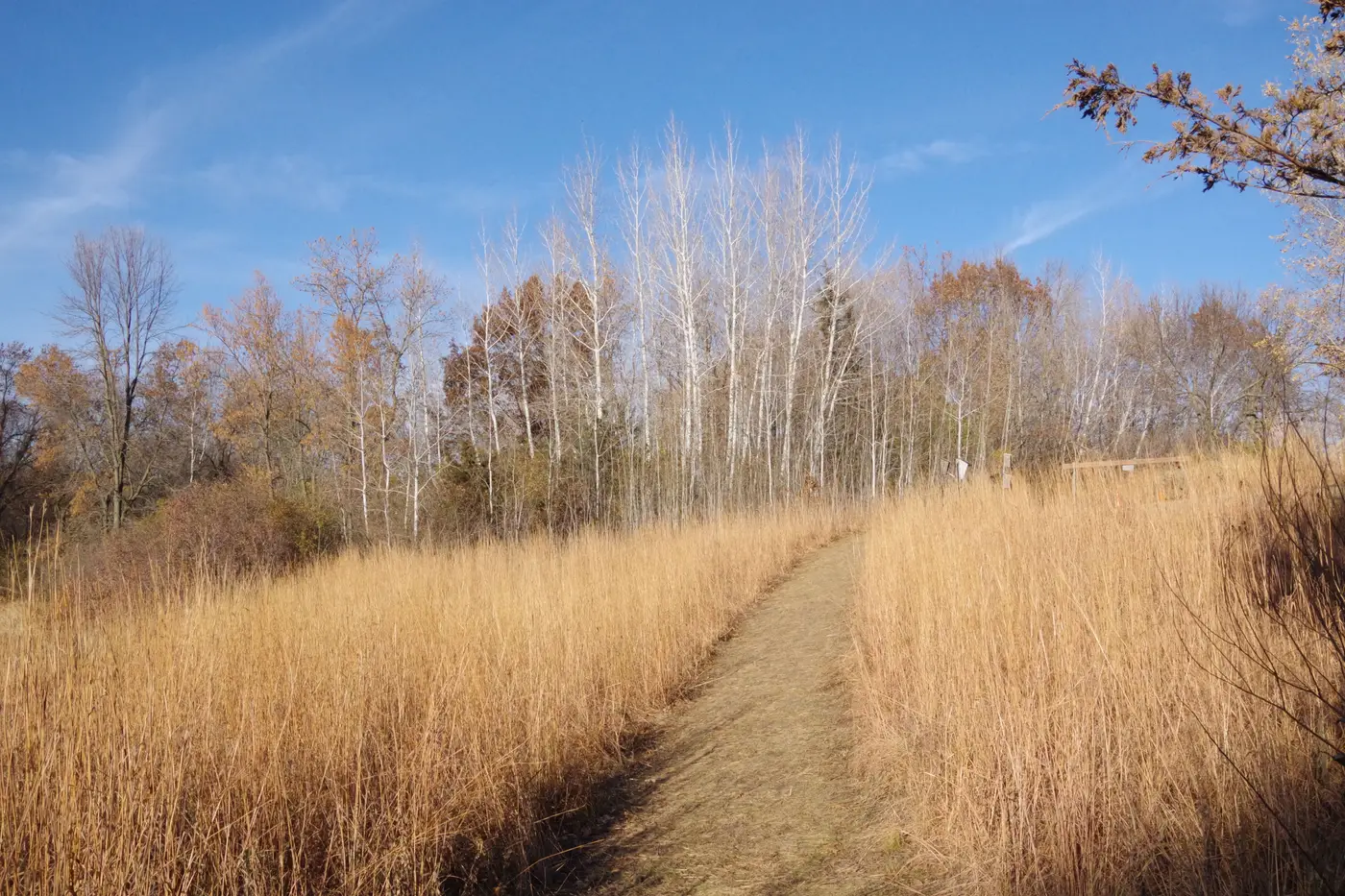
Foresters and ROW crews both know the saying: winter doesn't stop brush, it just stops showing it. Once the leaves drop, a corridor that looked thick and green in October can read almost bare in a December pass. The brush hasn't gone anywhere. The sensor has simply lost the chlorophyll signal it normally relies on to flag it.
If you're scheduling mow and clearing crews off quarterly imagery, understanding what leaf-off does to a multispectral read matters as much as the imagery itself.
What actually changes when the leaves drop
Multispectral sensors lean hard on chlorophyll reflectance to separate live woody growth from grass, soil, and gravel. Healthy leaf canopy bounces near-infrared light in a way that's easy to pick out against a mowed corridor. Strip the leaves off and that contrast mostly disappears. What's left is bark, bare stems, and whatever understory is still green, mostly grass and a few evergreens.
The sensor is doing exactly what it's built to do: reading reflectance, not shape. That's the same reason a forester walking the line in January squints at a stand of oak saplings and has to look twice to tell them from last year's dead stalks. The vegetation is there. The spectral signature that normally flags it just isn't doing as much work.
Practical effect: a stand of young hardwood saplings, maybe three to six feet tall and still a year or two from threatening the mow line, can show up fainter on a winter pass than it did in the summer image from the same spot. The stems are still growing. The read is just quieter.
Why a winter pass still earns its place in the schedule
None of this means winter imagery should get thrown out or waited on until spring green-up. A few reasons leaf-off passes still carry weight for a maintenance plan:
Bare stem structure is visible in a way canopy never lets you see. At sub-2-meter resolution, individual stem clusters and sapling groups stand out against dormant grass or snow cover in a way that's hard to pick apart in a leafed-in July pass. Density and spacing of woody stems along the edge of the corridor are often easier to count in winter, not harder.
Evergreens also get easier to flag in winter, not harder. Conifers and broadleaf evergreens that might get lost in a sea of summer green stand out clearly against dormant deciduous growth and bare ground, which is useful if your corridor runs through mixed stands where pine and cedar are the main offenders near the mow line.
The quarterly cadence itself carries the real weight here, more than any single pass. A segment that reads ambiguous in the December image gets checked against the September pass and the next March one. Growth that's genuinely closing in on the mow line shows up as a trend built across multiple quarters' spectral readings, winter included. That's the point of running this on a schedule instead of a once-a-year flyover: no single image has to carry the whole call.
What this means for how you read a winter report
Treat a winter segment ranking as a read on structure and trend, and lean on the prior quarter's canopy data for the species and density context. A segment that jumped in rank from September to December is worth a field check regardless of how faint the winter signal looks on its own, because stem growth doesn't reverse itself over a few cold months.
The segments that matter most for crew scheduling are the ones showing up consistently across two or three quarters, winter included. A single-quarter spike earns a second look, not a dispatch. That consistency is what turns a spectral reading into a dispatch decision.
Pipeline Vegetation runs this on a quarterly cadence specifically so no single season's imagery has to make the call alone, returning a segment-ranked list each pass so your crews go to the stretches actually closing in on the mow line.
If your winter reports have you second-guessing what's really growing back versus what's just hard to see this time of year, it might be worth seeing how a quarterly segment ranking handles that call for your corridor.