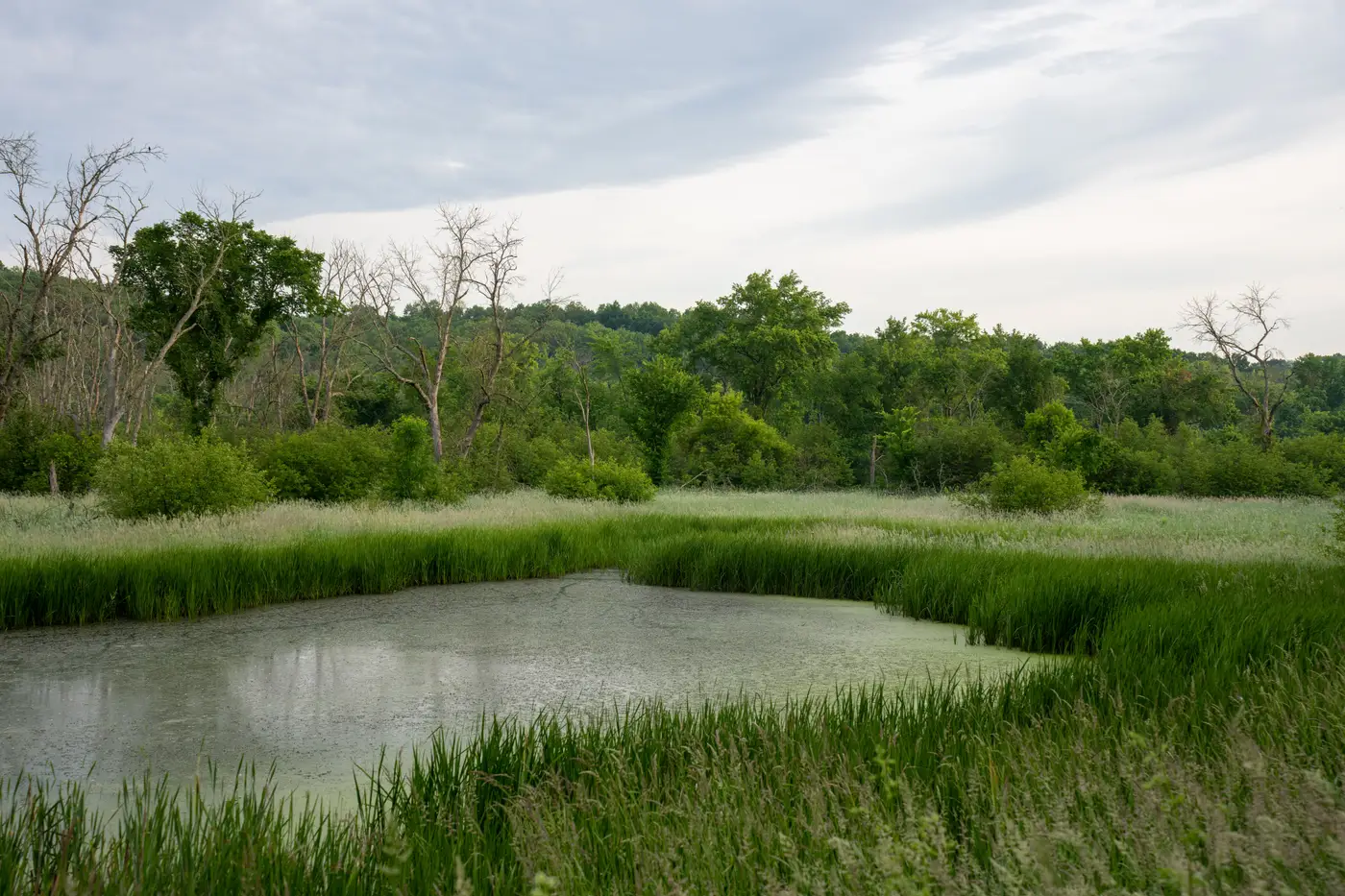
A wetland mow buffer is the strip of corridor, usually measured in feet from the wetland boundary or the top of bank, where a crew can't run standard mowing equipment the way they do on upland ROW. It's not a line anyone draws for fun. It comes out of the permit conditions attached to the pipeline, whether that's a Section 404 authorization, a state wetland program, or FERC certificate conditions on an interstate line, and it exists because tracked or wheeled equipment through saturated soil tears up root mats, changes drainage, and turns a maintenance pass into a restoration problem.
Most buffers you'll see run somewhere in the 25 to 50 foot range off the wetland edge, though the actual number is whatever's written into your specific permit or company environmental procedure for that segment. Inside that strip, equipment access is usually restricted to low ground-pressure machines, or hand crews with brush saws, or nothing at all until a dry-season window opens. Outside it, the crew runs the mower like normal. The buffer is a compliance boundary a foreman has to hold exactly, and running a bush hog through it because the GPS unit read three feet off can turn into a notice of violation.
Why the buffer number moves depending on what's growing
The buffer itself, the distance in feet, doesn't change season to season. What changes is how much it matters on a given pass. A wetland buffer bordering a stretch of corridor with light grass and forb growth is an afterthought. The same buffer next to a section where willow and alder have come up thick since spring is a real obstacle, because now the crew has to figure out how to clear woody stems encroaching on the mow line without putting a mower inside the restricted strip. That usually means routing a hand crew in on foot, which takes longer and costs more per linear foot than a mower pass ever does.
This is the part that doesn't show up on the permit map. The regulatory boundary is fixed. The vegetation pressing against it isn't, and a crew that only checks the buffer location once a year has no way of knowing which wetland edges are turning into a brush problem and which ones are still just grass.
Stream crossing setbacks work the same way, with less margin
A stream crossing setback is the wetland buffer's stricter cousin. Running equipment within a set distance of a stream crossing, often inside the riparian zone itself, risks sediment entering the water, and most permits treat that distance as non-negotiable regardless of how dry the ground looks that week. Crews often have to cross the stream itself to keep servicing both sides of the ROW, and the approved crossing point, usually a culvert or a hardened ford, is frequently the only legal place to get equipment across. If that crossing point sits a quarter mile from where the crew is working, the whole route for the day gets built around it.
How wet ground changes a crew's route
On paper, a mow crew works the corridor segment by segment in order. In practice, wet areas break that up. A crew hits a wetland buffer or stream setback and either stops the mower and switches to hand tools, detours to the next approved equipment crossing, or skips the segment and comes back with different gear later in the season. Multiply that across a hundred miles of easement and the planning problem isn't just "where is the growth," it's "where is the growth, and what can reach it."
That second question is where a lot of mow planning breaks down, because the people scheduling crews usually know where the wetlands are from the permit maps but not how close the brush has gotten to the buffer edge this quarter. Pipeline Vegetation builds that view from multispectral imagery captured on a quarterly cadence, ranking corridor segments by how far woody growth has closed in on the mow line, buffer zones included, so a planning lead can see which wet-area edges need a hand crew this cycle and which ones can wait.
If your crew keeps finding out about a brushy buffer edge after the mower's already parked next to it, a quarterly look at the corridor ahead of the schedule is worth setting up.